

Question: What is the Section 45B FICA tip credit and which employers can claim it?
FICA Tip Credit: Section 45B Now Reaches Salons and Barbershops
Restaurants have claimed the Section 45B FICA tip credit for years, and it now extends to barbering, nail care, and spa services. Here is what qualifies, why service charges do not, and how tip reporting drives the credit.
Small Business11 min read
 By Joanny Ibarbia, EA · CAA

Quick answer
The Section 45B FICA tip credit returns part of the Social Security and Medicare tax an employer pays on employee tips. It has long applied to food and beverage establishments, and it now also covers barbering and hair care, nail care, esthetics, and body or spa treatment services. The credit is part of the general business credit. It applies only to tips: mandatory service charges are non-tip wages, and the IRS says an employer cannot use them when computing the credit.
Key points
- Section 45B credits employers for the Social Security and Medicare tax they pay on employee tips, and it is claimed as part of the general business credit.
- The credit now reaches barbering and hair care, nail care, esthetics, and body or spa treatment services, not just food and beverage establishments.
- Mandatory service charges are non-tip wages, so the IRS bars employers from using them to compute the credit.
- Employees must report cash tips of $20 or more in a calendar month to their employer by the tenth day of the following month.
- Employers of more than ten tipped staff who together average over 80 hours on a typical business day also carry an annual Form 8027 filing duty.
What is the Section 45B FICA tip credit?
Every dollar your staff collect in tips is wage income, and you pay the employer share of Social Security and Medicare tax on it. Section 45B hands part of that payroll tax back. The IRS describes Form 8846 as the way certain food and beverage establishments claim a credit for the Social Security and Medicare taxes an employer paid on employee tips, and it confirms the credit is "part of the general business credit".[1] That distinction matters: you are not deducting an expense, you are reducing tax owed dollar for dollar. The agency states that employers may be eligible for the FICA tip credit under section 45B "for certain tips on which the employer paid Social Security and Medicare taxes".[2] The word certain carries real weight there, because not every payment a customer leaves behind counts as a tip. Employers who treat this as a filing season afterthought tend to lose it, which is why it belongs inside your payroll services routine rather than a once a year scramble.
Which employers can claim the tip credit?
For decades this was, in practice, a restaurant credit. That changed when the WFTC amended section 45B to extend the credit past food or beverage establishments.[3] The credit now takes in tips received by employees who perform several personal care services, which pulls a wide slice of the South Florida grooming and wellness economy into a benefit it previously had no claim to. If you operate a salon, a barbershop, a nail studio, or a spa, and your staff receive tips that run through your payroll, Section 45B is now a live question for you. The same IRS guidance points employers to Form 8846 and its instructions for how to calculate and claim the credit.[3] Restaurants keep their long standing claim, and we work with both groups: see our restaurant and food service accounting practice and our salon and personal services accounting practice.
- Food and beverage establishments, the original and still largest category
- Barbering and hair care
- Nail care
- Esthetics
- Body or spa treatment services

Tip or service charge: which payments actually qualify?
This is where most of the money is won or lost. A tip is voluntary: the customer decides whether to pay it and how much. A service charge is imposed by the business, and the customer has no say. The IRS treats a charge the customer must pay as a non-tip wage rather than a tip, and it is explicit that an employer cannot use those non-tip wages when computing the Section 45B credit, because they are not tips at all.[4] Those amounts still carry Social Security tax, Medicare tax, and federal income tax withholding, so you pay the payroll tax without earning any credit on it.[4] A business that funnels a growing share of its gratuity revenue through automatic charges is quietly shrinking its own credit base every year.
| Payment | Is it a tip? | Usable for the Section 45B credit? |
|---|---|---|
| Cash the customer chooses to leave | Yes, it is voluntary and customer set | Yes, where you paid Social Security and Medicare tax on it |
| Charged tips on a card, paid out to staff | Yes | Yes |
| Tips redistributed through a tip sharing arrangement | Yes | Yes |
| Large party charge added automatically | No, it is a non-tip wage | No |
| Bottle service charge at a restaurant or night club | No, it is a non-tip wage | No |
| Room service or contracted luggage assistance charge | No, it is a non-tip wage | No |
| Mandated delivery charge | No, it is a non-tip wage | No |
How does employee tip reporting drive the credit?
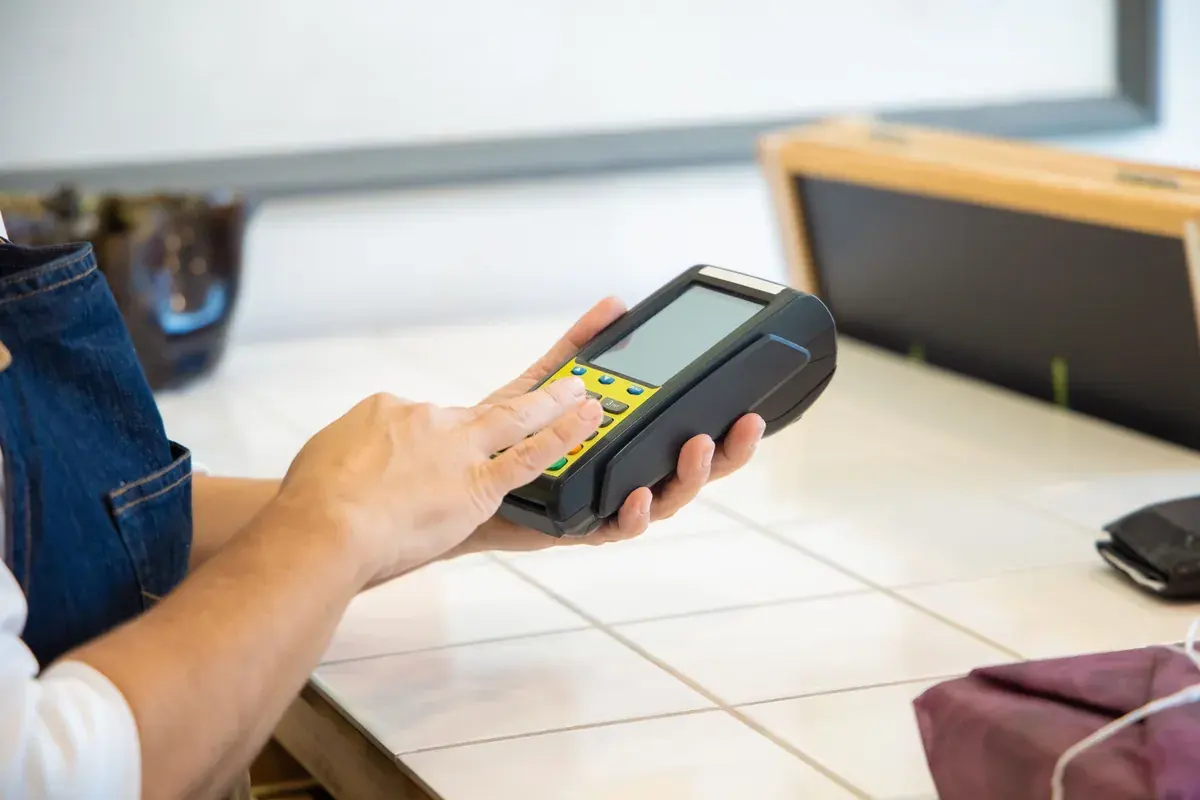
The credit is built on what your employees report to you, so the reporting process is the credit process. An employee who receives cash tips of $20 or more in a calendar month has to report the total to their employer, and that written report is due by the tenth day of the following month.[5] Those reports are what you use to withhold correctly, what you use to pay the employer share, and ultimately what substantiates the tips your credit is computed on. When reports arrive late, arrive incomplete, or never arrive at all, the credit thins out with them. Practically, that means a written monthly tip statement from every tipped employee, collected every month and retained, not an informal understanding at the end of a shift.
Which payroll taxes does the credit actually touch?
The credit tracks the employer half of FICA. Social Security is charged at 6.2% on the employer and 6.2% on the employee, or 12.4% in total, and Medicare runs at 1.45% each side, or 2.9% in total.[6] The credit follows the employer portion you actually paid on qualifying tips, which is why an accurate payroll record, and not an estimate, is the starting point. One limit shapes the arithmetic at the top end: only Social Security carries a wage base, and for earnings in 2026 that base limit is $184,500 and Medicare carries no wage base at all.[7] A long tenured, high earning tipped employee can therefore stop generating employer Social Security tax partway through the year even as Medicare keeps accruing. Because the computation depends on per employee payroll detail, we handle it inside business tax return preparation rather than as a standalone worksheet.
Do you also have to file Form 8027?
Form 8027 is a separate obligation from the credit, and plenty of operators meet one without realizing they have tripped the other. An employer running a large food or beverage establishment must file Form 8027 each calendar year to report receipts and reported tips, and may also be required to allocate tips among employees.[8] The IRS defines that establishment by three conditions together: tipping is customary, food or beverages are consumed on the premises, and the employer normally employs more than ten people whose combined hours average over 80 on a typical business day.[8] Note that the head count test is about total staff, not only tipped staff, which is how a mid size Miami restaurant with a large kitchen crosses the line sooner than its owner expects.

What happens if employees underreport their tips?
There is a protective rule here that is widely misunderstood as a loophole. If an employee fails to report tips to you, you are not liable for the employer share of Social Security and Medicare tax on those unreported tips until the IRS makes a notice and demand for the tax on you.[9] That sounds like relief, and in a narrow sense it is, but read it against the credit: tax you never paid is tax you can never claim a credit for. Chronic underreporting therefore costs you twice, first in the credit you forfeit and then in the exposure that a notice and demand can create later. If a notice does land, that is representation territory, and an IRS representation with an Enrolled Agent approach beats improvising a response.
What records defend the credit in an examination?
Assume an examiner will ask you to prove the line you drew between tips and service charges. The IRS says that in an examination it may ask the employer to show how sales subject to service charges are distinguished from sales subject to tipping, and that examiners may request Point of Sale records, including the summary reports covering sales transactions.[10] That is a documentation standard, not a conversation, and it is decided by how your point of sale system was configured long before anyone asked. Clean books make this a short meeting: see small business accounting.
- Monthly written tip reports from every tipped employee, collected and retained without gaps
- Point of Sale configuration that separates voluntary tips from mandatory charges at the transaction level
- Summary sales reports that reconcile to the payroll records behind the credit
- Payroll registers showing the employer Social Security and Medicare tax actually paid on tips
- A written record of which service categories your tipped staff perform, now that coverage extends past food service
Who should handle the tip credit for a Miami business?
The employer credit is often confused with the separate deduction employees may claim on their own returns for qualified tips; those are different rules aimed at different taxpayers, and we cover the employee side in the employee deduction for tips and overtime. On the employer side, the work is unglamorous and continuous: configure the point of sale correctly, collect tip reports every month, pay and record the employer FICA accurately, then claim what those records support. Top Pro Accounting is led by an Enrolled Agent, and we run tip heavy payroll for South Florida restaurants, salons, and spas year round, so the credit is computed from live records instead of reconstructed in April.
Frequently asked questions
Does the FICA tip credit apply to salons, barbershops, and spas?
Yes. The WFTC amended section 45B to extend the credit beyond food or beverage establishments to tips earned by employees who provide barbering and hair care, nail care, esthetics, and body or spa treatment services. If your tipped staff perform those services and you pay employer Social Security and Medicare tax on their reported tips, the credit is worth evaluating.
Can I include mandatory service charges in the tip credit?
No. A charge the customer is required to pay is a non-tip wage rather than a tip, and the IRS states directly that an employer cannot use those non-tip wages when computing the credit under section 45B, because the amounts are not tips. You still owe Social Security tax, Medicare tax, and income tax withholding on them, so the charge costs you payroll tax without generating any credit.
How much do employees have to report in tips?
An employee who receives cash tips of $20 or more in a calendar month must report the total amount to their employer, and the written report is due by the tenth day of the following month. Those monthly reports are the evidentiary base for the employer credit, so a business that collects them consistently protects the claim.
Which taxes does the Section 45B credit offset?
It follows the employer share of FICA paid on qualifying tips. Social Security runs at 6.2% for the employer and 6.2% for the employee, or 12.4% total, and Medicare is 1.45% on each side, or 2.9% total. Only Social Security has a wage base, which is $184,500 for earnings in 2026, so a high earning tipped employee can stop generating employer Social Security tax partway through the year while Medicare continues.
Is Form 8027 required in order to claim the credit?
They are separate obligations. Form 8027 is an annual information return that an employer operating a large food or beverage establishment must file to report receipts and reported tips, and that employer may also have to allocate tips among employees. An establishment is large when tipping is customary, food or beverages are consumed on the premises, and the employer normally employs more than ten people whose combined hours average over 80 on a typical business day. Many smaller businesses claim the credit without ever filing Form 8027.
What if my employees never report their tips to me?
Until the IRS makes a notice and demand for the tax, an employer is not liable for the employer share of Social Security and Medicare taxes on tips the employee failed to report. That is not a benefit in credit terms, though: the Section 45B credit follows employer FICA you actually paid on reported tips, so unreported tips generate no credit and leave an exposure the IRS can act on later.
Sources
- About Form 8846, Credit for Employer Social Security and Medicare Taxes Paid on Certain Employee Tips · Internal Revenue Service
- Tip recordkeeping and reporting · Internal Revenue Service
- Tip recordkeeping and reporting: FICA tip credit · Internal Revenue Service
- Topic no. 761, Tips, withholding and reporting · Internal Revenue Service
- Topic no. 761, Tips, withholding and reporting: employee reporting · Internal Revenue Service
- Topic no. 751, Social Security and Medicare withholding rates · Internal Revenue Service
- Topic no. 751, Social Security and Medicare withholding rates: wage base limits · Internal Revenue Service
- Topic no. 761, Tips, withholding and reporting: allocated tips · Internal Revenue Service
- Tip recordkeeping and reporting: unreported tips · Internal Revenue Service
- Tip recordkeeping and reporting: distributed service charges · Internal Revenue Service
Continue reading

Section 45E Retirement Startup Credit: Up To $5,000 On Form 8881
A small employer starting a new SEP, SIMPLE IRA, or 401(k) can claim a Section 45E tax credit of up to $5,000 a year for three years on Form 8881, with SECURE 2.0 now covering 100 percent of costs at 50 or fewer employees.
Section 41 R&D Credit on Form 6765: $500,000 Payroll Offset and Section G Rules
The Section 41 research credit is worth 20% of qualifying research spending above a base amount, or 15.8% with the Section 280C election. Covers the four-part test, the $500,000 payroll tax offset, and Section G reporting for tax years beginning after 2025.

Work Opportunity Tax Credit in 2026: WOTC Expired for Hires Starting After 2025
The Work Opportunity Tax Credit is authorized only for workers who begin work on or before December 31, 2025. Employers can still certify qualifying 2025 hires, claim the credit on Form 5884, and carry unused credit forward.
About the author
Founder & Principal · Enrolled Agent (EA)
Joanny Ibarbia is an Enrolled Agent with unlimited rights to represent taxpayers before the IRS, and a Certifying Acceptance Agent for ITIN applications. He leads the bilingual tax and accounting practice at Top Pro Accounting.
- EA
- CAA
- Harvard Certified
- QuickBooks ProAdvisor
Image credits
- Photo by Matheus Bertelli Pexels
- Photo by Ionela Mat Pexels
- Photo by Kampus Production Pexels
- Photo by Rene Terp Pexels